What Is a Fake Address Generator?
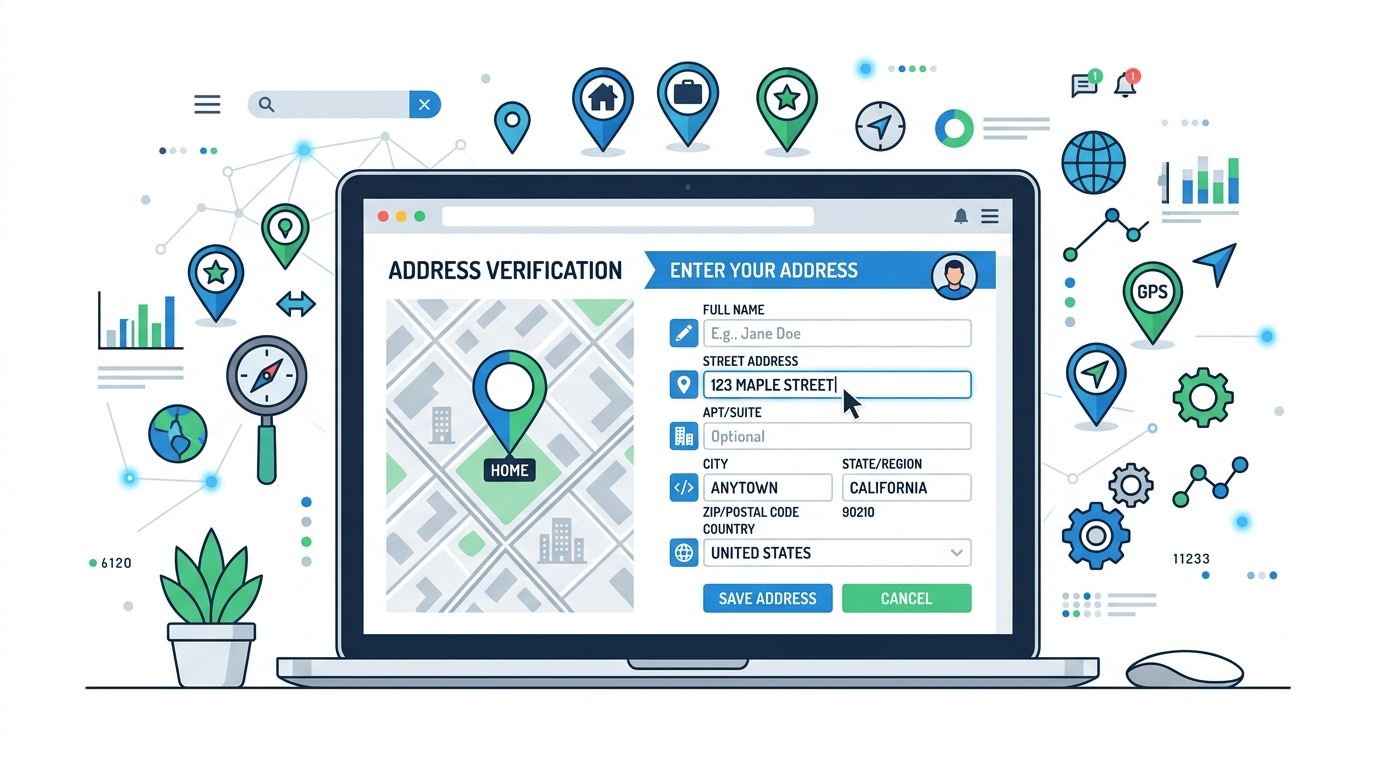
A fake address generator is a free online tool that creates realistic, fictional mailing addresses — including street number, street name, city, state or province, ZIP or postal code, and country — without linking to any real person or location.
Unlike searching for a random real address on Google Maps, a fake address generator builds fictional address strings from curated datasets and regional formatting rules. The result is an address that looks completely real but is entirely fabricated — perfect for situations where you need plausible address data without using someone’s private information.
For example, a tool might generate:
1482 Elmwood Drive, Austin, TX 78701, United States
or
23 Baker Street, London, W1U 6AP, United Kingdom
These addresses follow proper formatting conventions for their respective countries, pass basic form validation, but do not map to any real individual’s home or business.
Fake address generators are used by millions of people worldwide — from software developers and QA engineers to privacy-conscious individuals and students learning data entry.
Why Do People Use a Fake Address Generator?
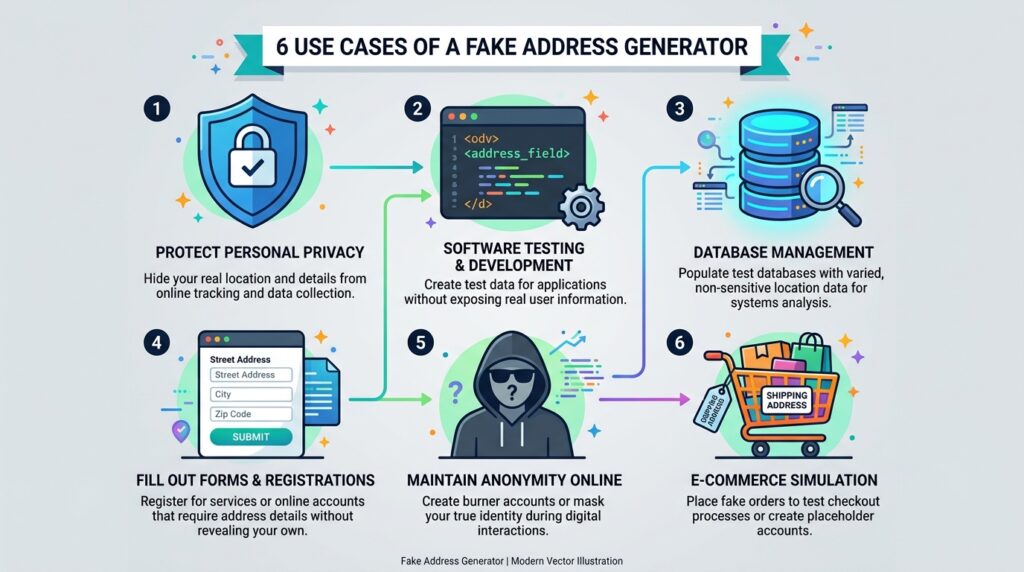
The demand for fake address generators has grown significantly as more of our lives move online. Here are the core reasons people turn to these tools:
Privacy Protection: When a website demands your address just to view content or download a file, many users feel uncomfortable sharing personal data. A generated fake address lets you move through these gatekeepers without exposing where you actually live.
Software Development and Testing: Applications that handle shipping, billing, or registration need to be tested with realistic address inputs. Using real customer addresses during development creates unnecessary privacy risk. Fake addresses fill the gap perfectly.
QA Form Validation: Testing whether address input fields accept valid entries and reject malformed ones is a standard part of quality assurance. A fake address generator produces limitless variations for rigorous testing.
Database Seeding: Developers building new applications often need to populate databases with sample data that looks real. Fake addresses allow them to create thousands of test user profiles without touching private information.
Online Anonymity: Some users simply prefer not to hand out their home address to websites they don’t fully trust. A fake address helps them stay anonymous.
Educational Purposes: Students and instructors working on data entry exercises, address validation systems, or geographic information projects use generated fake addresses as harmless placeholder data.
E-Commerce Checkout Testing: Verifying that a shopping cart correctly handles addresses from different states, countries, or postal code formats requires broad test data — and fake address generators deliver exactly that.
How Does a Fake Address Generator Work?
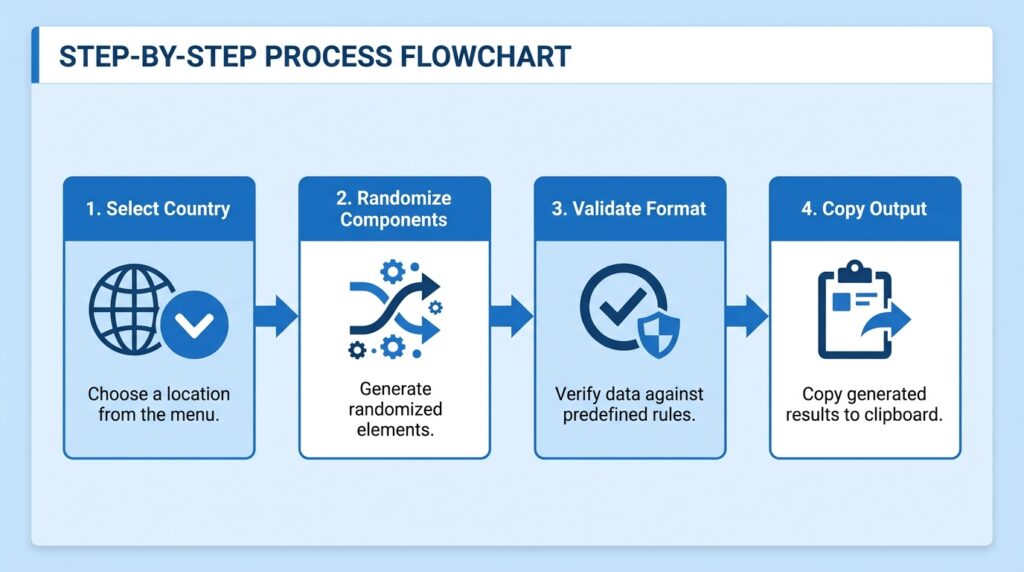
Understanding the mechanics behind a fake address generator helps explain why its output looks so convincingly real.
Step 1 — Country-Specific Format Rules
The tool first identifies the address formatting conventions for the selected country. Different countries structure addresses differently:
- United States: Street Number + Street Name, City, State Abbreviation, 5-digit ZIP Code
- United Kingdom: House Number + Street Name, Town, Postcode (alphanumeric, e.g., SW1A 2AA)
- Germany: Street Name + House Number, Postal Code, City
- Australia: Street Number + Street Name, Suburb, State, Postcode
By loading these rules first, the generator ensures every output follows local conventions and would pass a basic address format check.
Step 2 — Randomized Component Generation
The generator pulls from pre-built libraries of:
- Street names (common names like “Maple Avenue,” “Oak Lane,” or country-specific equivalents)
- Street numbers (randomly chosen integers within realistic ranges)
- City and town names (drawn from actual geographic databases)
- State, province, or region names (matched to the selected country)
- Postal/ZIP codes (formatted to match real codes without copying specific ones)
Each of these components is chosen randomly from the database and assembled into a single address string.
Step 3 — Syntactic Validation
The algorithm runs a quick internal check to ensure the assembled address follows realistic patterns. For example, it won’t pair a Texas ZIP code format with a New York city name, or generate a UK postcode that doesn’t follow alphanumeric conventions.
Step 4 — Output and Copy
The finished address is displayed to the user in the proper format, ready to be copied into a form, spreadsheet, script, or database — no account required, no personal data collected.
Top Use Cases for Fake Address Generators
1. Software Testing and QA
This is by far the most common professional use case. Software developers and QA engineers use fake addresses to:
- Test address input fields in registration and checkout forms
- Verify that form validation correctly accepts or rejects different address formats
- Simulate user profiles from multiple geographic regions
- Test region-based pricing, shipping calculations, or tax logic
- Stress-test address APIs with bulk fake address data
Tools like Testsigma’s Random Address Generator are specifically designed for this workflow, supporting 130+ countries and instant output.
2. Database Population
When building or testing a new application, developers often need hundreds or thousands of sample user records. Manually creating these is impractical. Fake address generators let you produce batch datasets quickly, populating databases with realistic-looking address data for development, staging, and demonstration environments.
3. Privacy-Conscious Online Registration
Many websites require an address to register for newsletters, promotions, or downloads. When you’d rather not share your real home address with an unfamiliar platform, a generated fake address satisfies the form requirement without revealing personal data.
4. UI and UX Design Mockups
Designers creating wireframes, prototypes, or app mockups need realistic placeholder content. Instead of typing “123 Fake Street” in every address field, a generator provides varied, region-specific examples that make the design look credible during presentations and user testing.
5. E-Commerce and Checkout Testing
Online store owners and developers need to verify that checkout flows handle:
- Different domestic shipping address formats
- International addresses with varying postal code structures
- Edge cases like very long street names or unusual characters
Fake address generators supply unlimited variations for comprehensive testing.
6. API Testing
Applications that rely on third-party address verification APIs, geocoding services, or postal validation tools need test inputs to verify those integrations work correctly. Fake addresses provide safe, repeatable inputs for these tests.
7. Education and Training
Teachers, trainers, and course creators use fake addresses to provide students with realistic data entry exercises, demonstrate address validation concepts, or populate sample datasets — all without involving any real private information.
8. Geolocation Feature Testing
If your app displays different content, pricing, or features based on the user’s location, you need addresses from multiple cities and states to verify that behavior. Fake address generators from different regions let you simulate any location.
How to Generate a Fake Address (Step-by-Step)
Most fake address generator tools work with a nearly identical simple process:
Step 1 — Open the Tool
Visit a fake address generator website. No account creation or login is required for most free tools.
Step 2 — Select a Country
Use the dropdown menu to choose the country whose address format you need. Tools like FakeXY and Testsigma’s generator support 100+ countries, while tools like USAddressGenerator.com specialize in American formats.
Step 3 — Set the Quantity
Choose how many addresses you need — whether it’s 1 for a quick form fill, or 100+ for database seeding.
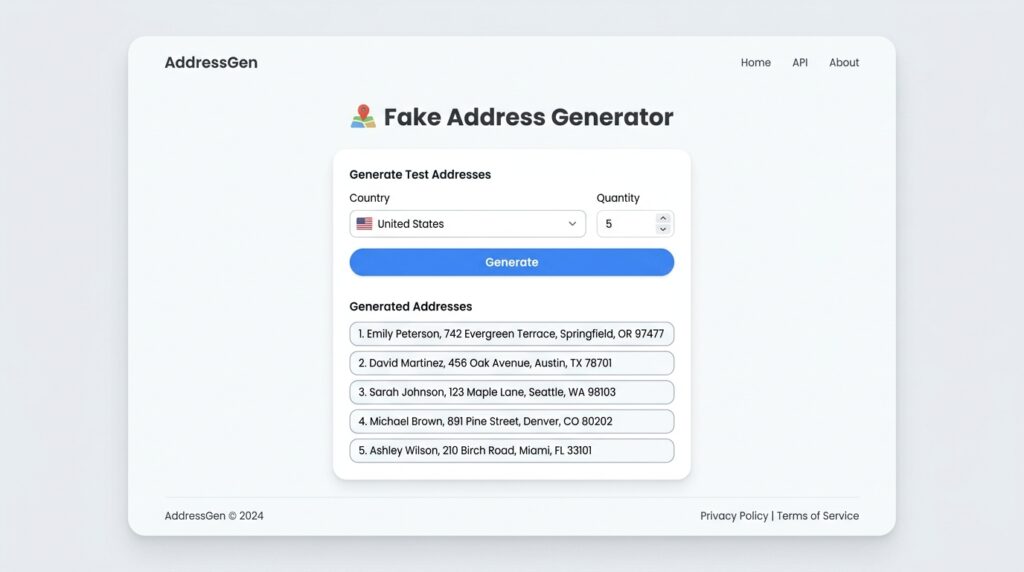
Step 4 — Click “Generate”
Hit the generate button. The tool will instantly produce complete address strings including all components: street, city, state, ZIP/postal code, and country.
Step 5 — Copy and Use
Copy the output to your clipboard and paste it wherever needed — forms, spreadsheets, test scripts, or design mockups. Most tools include a one-click copy button for each field.
Fake Address Formats by Country
Different countries use very different address formats. Here’s a quick reference:
| Country | Format Example |
|---|---|
| 🇺🇸 United States | 1482 Oak Lane, Austin, TX 78701, USA |
| 🇬🇧 United Kingdom | 47 George Street, Edinburgh, EH2 2LQ, UK |
| 🇨🇦 Canada | 235 Queen Street, Toronto, ON M5V 1Z7, Canada |
| 🇦🇺 Australia | 91 Collins Street, Melbourne VIC 3000, Australia |
| 🇩🇪 Germany | Hauptstraße 17, 10115 Berlin, Germany |
| 🇫🇷 France | 42 Rue de Rivoli, 75001 Paris, France |
| 🇮🇳 India | 14, MG Road, Bengaluru, Karnataka 560001, India |
| 🇵🇰 Pakistan | House 5, Street 12, F-7/2, Islamabad 44000, Pakistan |
| 🇧🇷 Brazil | Rua das Flores, 123, São Paulo, SP 01311-000, Brazil |
| 🇯🇵 Japan | 1-2-3 Shinjuku, Shinjuku-ku, Tokyo 160-0022, Japan |
A good fake address generator respects these differences and produces appropriately formatted output based on your country selection — not just an American-style address plastered with a different country name.
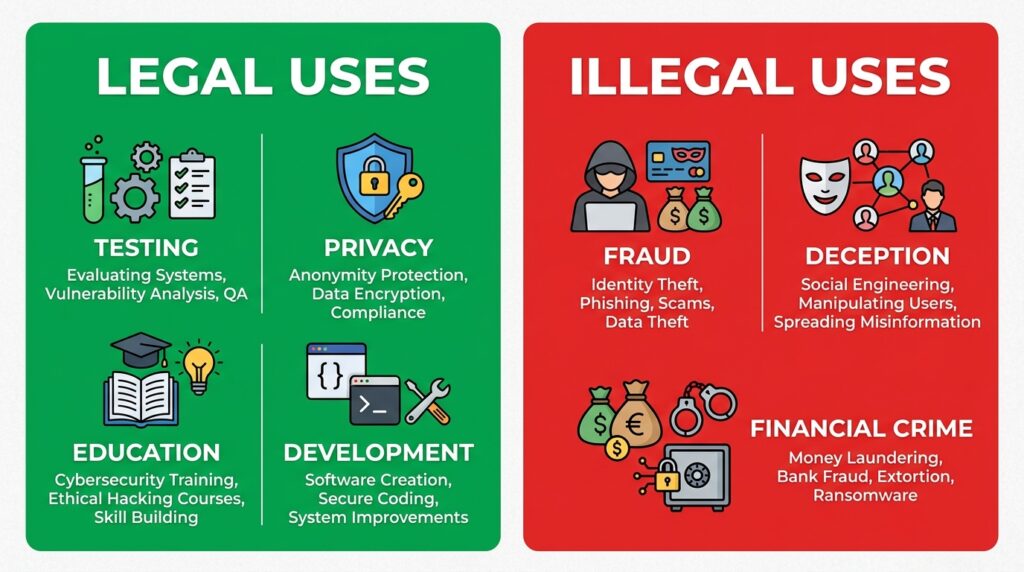
Is Using a Fake Address Generator Legal?
This is one of the most commonly asked questions — and the answer depends entirely on how you use the tool.
✅ Legal and Ethical Uses
- Software and application testing
- Database population for development environments
- UI/UX design mockups
- Educational exercises
- Protecting your privacy from non-essential data collection
- API integration testing
- QA form validation
❌ Illegal and Unethical Uses
- Using a fake address to commit fraud or deception
- Bypassing identity verification systems required by law
- Providing fake billing or shipping addresses in real financial transactions
- Misrepresenting your location for regulated services
- Any use designed to deceive, mislead, or harm others
As the Testsigma documentation clearly states, these tools are intended purely for testing, development, and educational purposes. No reputable fake address generator tool endorses or supports fraudulent use.
The rule of thumb: if you’re using a fake address where a real one is legally required — for financial transactions, identity verification, or government documentation — that is fraudulent regardless of the tool you use. For privacy-protective or development purposes, it is entirely legal in most jurisdictions.
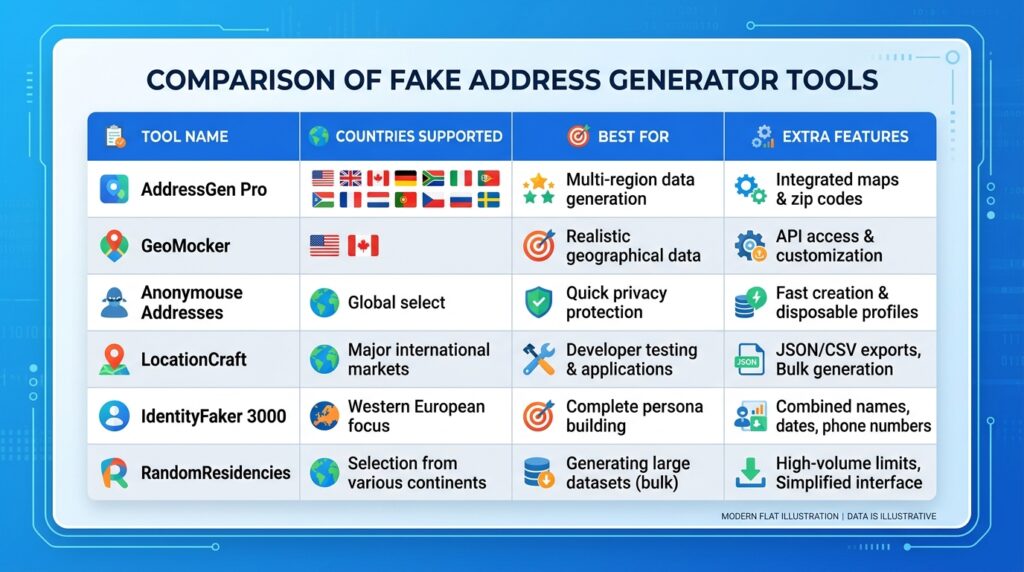
Best Free Fake Address Generator Tools in 2025
1. FakeAddressGenerator.com
One of the most established tools in the space, offering fake address generation for dozens of countries. It includes additional fake identity data like names, phone numbers, and email addresses alongside addresses — useful for creating complete mock user profiles.
Best for: Full fake identity generation, multi-field profiles
Countries supported: 40+
Extra features: Names, phones, emails, credit card numbers (for testing only)
2. FakeXY.com
FakeXY offers a clean, minimal interface focused on fast address generation. It’s particularly popular for generating international addresses and supports a wide range of countries with country-specific formatting.
Best for: Quick international address generation
Interface: Very clean and easy to use
Speed: Instant generation
3. Testsigma Random Address Generator
Built specifically for developers and QA professionals, Testsigma’s tool supports 130+ countries and emphasizes privacy-by-design. No personal data is collected or stored, and the output follows strict regional formatting rules.
Best for: Professional software testing and QA workflows
Countries supported: 130+
Extra features: Batch generation, developer-focused documentation
Link: testsigma.com/free-tools/random-address-generator
4. FakeNameGenerator.com
One of the most feature-rich fake identity generators available. Beyond addresses, it generates complete fictional identities including names, passwords, browser user agents, vehicle data, and more. Addresses follow country-specific formatting.
Best for: Generating complete fake identity profiles
Countries supported: Many, with strong US and European coverage
Extra features: Extremely detailed fake profile data
5. BestRandoms.com – Random Address Generator
BestRandoms offers a simple, no-frills approach to random address generation. It supports multiple countries and is well-suited for quick, one-off address generation without extra features getting in the way.
Best for: Simple, fast random addresses
Interface: Minimal and straightforward
Countries supported: US, UK, and several others
6. USAddressGenerator.com
As the name suggests, this tool specializes exclusively in United States addresses. It generates complete US address sheets including street, city, state, ZIP code, and phone number — all specific to American formatting standards.
Best for: US-specific address generation
Extra features: US phone numbers, IP addresses, PO Box addresses, Apple ID addresses
Link: usaddressgenerator.com
Fake Address Generator for Developers and Testers
If you’re a developer or QA engineer, fake address generators are more than a convenience — they’re a critical part of building privacy-compliant, regulation-friendly test environments.
Why You Should Never Use Real Addresses for Testing
Using real user addresses in test environments creates multiple serious problems:
Data Privacy Regulations: Under GDPR in Europe, CCPA in California, and similar laws worldwide, unnecessarily storing or processing real personal data — even in a test database — can create legal liability. Synthetic fake addresses are completely regulation-safe.
Security Risk: Test environments are often less secure than production environments. Using real address data in testing exposes that data to additional risk if the test system is breached.
Data Quality Issues: Real addresses change over time. A database seeded with real addresses will develop inaccuracies as people move. Fake addresses are static by design.
Integration with Testing Workflows
Fake address generators integrate naturally into common developer workflows:
- Manual Testing: Generate an address, paste it into the form you’re testing
- Automated Scripts: Use batch-generated addresses as inputs for automated test suites
- Continuous Integration: Include generated address datasets in CI test fixtures
- API Testing Tools: Use tools like Postman or Insomnia with fake address inputs to test address validation APIs
For advanced scenarios, tools like Mockaroo allow you to export up to 1,000 rows of fake data (including addresses) in CSV, JSON, SQL, and Excel formats — directly importable into test databases and automation tools.
Country-Specific Testing
If you’re building an internationally-available application, you need to verify that your address handling works for every supported country. A fake address generator that supports 100+ countries lets you test UK postcodes, German address formats, Japanese address structure, and Pakistani addresses from one interface — without needing contacts in each of those countries.
Fake Address Generator vs. Random Address Generator – What’s the Difference?
You’ll often see these two terms used interchangeably online. The distinction is mostly one of intent rather than technical difference:
| Aspect | Fake Address Generator | Random Address Generator |
|---|---|---|
| Primary audience | Privacy-focused users, developers | Developers, testers, data analysts |
| Connotation | Emphasizes “not real” nature | Emphasizes randomness |
| Output | Identical — formatted address strings | Identical — formatted address strings |
| Typical use | Privacy protection, online forms | Software testing, database seeding |
| Legal intent | Privacy-conscious, legitimate | Technical and development-focused |
In practice, both tools work the same way and produce the same type of output. Whether you search for “fake address generator” or “random address generator,” you’ll find the same category of tools. The choice of term often reflects the user’s purpose more than any technical difference in the tools themselves.
Tips for Choosing the Right Fake Address Generator
Not all fake address generators are equal. Here’s what to look for when selecting a tool:
1. Country Coverage
If you need addresses from multiple countries, choose a tool that supports regional formatting for your required locations. Testsigma covers 130+ countries; USAddressGenerator.com covers only the US.
2. Data Realism
The best tools use real city names, real street name conventions, and properly formatted postal codes — not obviously placeholder text like “AAAA BB 12345.”
3. Batch Generation
If you need dozens or hundreds of addresses for database seeding, choose a tool that lets you specify quantity and generate in bulk.
4. Additional Fields
Some use cases require more than just an address. If you need phone numbers, names, or emails alongside addresses, tools like FakeNameGenerator.com provide complete identity packages.
5. Export Options
For developer workflows, look for tools that offer CSV or JSON export, making it easy to import generated data into test databases or automation tools.
6. Privacy Policy
Since you’re visiting a website to use these tools, check that the tool doesn’t collect, store, or share any of the data you generate or any usage data that could identify you.
7. No Login Required
The best fake address generators require no account creation. You should be able to generate addresses instantly without sharing any personal information.
Common FAQs About Fake Address Generators
In most cases, yes. Standard address form validation only checks format — it verifies that a ZIP code is 5 digits or that a postcode has the right alphanumeric pattern, not that the specific address actually exists. Fake addresses generated by quality tools will pass these checks.
Basic form validation cannot detect fake addresses. However, some services use Address Verification Systems (AVS) for billing purposes, or tie address verification to credit card processing — these systems may flag addresses that don’t match real postal records. For general web forms, fake addresses are undetectable.
No. For any actual financial transaction or real delivery, you must use a real address. Using a fake address for billing is fraudulent, and a fake shipping address means your order will never arrive.
Yes, provided you use a reputable, established tool. Stick to well-known tools like those listed in this article. As always, use a password manager and avoid entering any real personal data on unfamiliar websites.
It depends on the tool. Some tools like Testsigma support 130+ countries; others focus on specific regions. For Pakistani, Indian, or other South Asian addresses, look for tools that explicitly list those regions in their country support.
For maximum privacy, yes. A fake address hides your physical location from a web form; a VPN hides your IP address. If your goal is complete anonymity, using both together provides the most comprehensive protection.
Absolutely — this is one of the most common professional use cases. Generate fake addresses and use them as inputs to test address validation APIs, geocoding services, or address normalization tools.
Yes. Some tools like BestRandoms.com offer Pakistan-specific addresses formatted for Pakistani conventions. Tools like Testsigma also include Pakistani address format support in their country list.
Most tools are entirely free with no limits on the number of addresses you can generate. Some specialized tools may limit batch exports on free plans, but the leading tools listed here impose no limits.
Reputable tools explicitly state that no generated data is stored or associated with your usage. The addresses are generated on-demand and discarded. Always review a tool’s privacy policy if you have concerns.

Conclusion
A fake address generator is one of those deceptively simple tools that serves a wide range of people — from individual users protecting their privacy to enterprise development teams building and testing complex applications.
The core value proposition is straightforward: you get realistic, properly formatted address data that can be used freely, without ever touching real personal information. That makes these tools essential for software developers, QA engineers, database administrators, UX designers, and privacy-conscious individuals alike.
When choosing a fake address generator, prioritize tools that offer country-specific formatting, realistic output, batch generation for developer workflows, and a clear privacy policy. The leading tools — including FakeAddressGenerator.com, Testsigma, FakeNameGenerator.com, FakeXY, and USAddressGenerator.com — all meet these standards and are freely accessible without registration.
Use them responsibly. For testing, privacy protection, education, and development — fake address generators are an entirely legitimate and valuable part of the modern digital toolkit. For fraud, deception, or bypassing legally required verification — they are not a loophole, and misuse carries real legal consequences.
Generate, test, protect your privacy, and build better software.
It’s interesting how fake address generators balance realism with privacy. They seem especially handy for testing forms or practicing data entry without using anyone’s real information, which is such a simple yet clever solution.
The distinction you made between randomly scraped real addresses and generated fictional ones based on regional formatting rules is crucial for anyone doing data entry or QA testing. This approach really solves the common validation challenge where systems reject valid-looking formats that actually belong to real people. It’s great to see a tool that prioritizes both realism and privacy in this way.