Introduction: Why People Search for a Random Street Address in the USA
Every day, millions of people around the world need a random street address in USA. Maybe you are a software developer stress-testing a new checkout form. Maybe you are protecting your privacy from a sketchy website that demands your home address before it lets you access free content. Or perhaps you are a student working through a UI/UX project who simply needs realistic dummy data.
Whatever the reason, the demand for realistic, properly formatted fake US addresses has exploded in the digital age. According to a 2025 K2view survey, 93% of companies are not fully compliant with data privacy regulations in their testing environments — and synthetic address data like randomly generated US addresses is one of the fastest ways to close that gap.
This guide covers everything you need to know: what a random US address generator actually is, how it works under the hood, the best free tools available today, legal and ethical considerations, and how to choose the right tool for your specific need.
📍 Address Generator 🌐 Live API
Realistic addresses from Random User API · Country‑specific
Generated Address
What Is a Random Street Address in the USA?
A random street address in the USA is a fictitious but realistically formatted postal address that follows the standard American address structure. It is not a real, deliverable location — it is a synthetic string of data that mimics how a genuine address looks.
A typical US address follows this format:
- [House Number] [Street Name] [Street Type]
- [City], [State Abbreviation] [5-Digit ZIP Code]
- [Country: United States]
Example: 4382 Elliott Street, Londonderry, NH 03053, United States
Every element — the house number, street name, city, state, and ZIP code — follows real American postal conventions even though the specific combination is entirely fictional. This is what makes these addresses useful: they pass front-end validation checks on most websites and forms without exposing anyone’s real personal data.
How Does a Random US Address Generator Work?
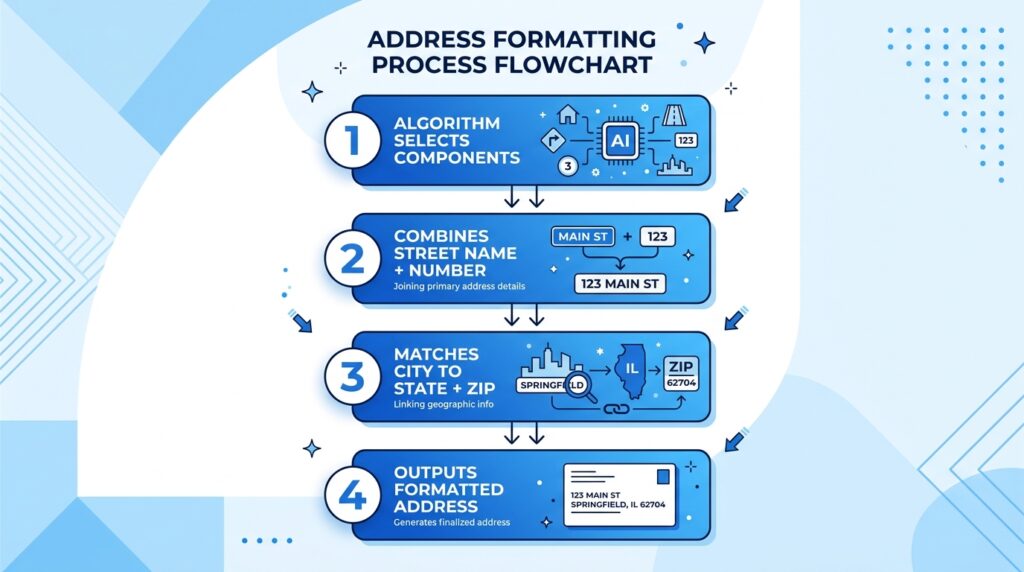
Behind every fake address generator is a surprisingly elegant algorithm. Here is how leading tools like Testsigma, BestRandoms, and FakeAddressGenerator produce their results:
1. Component Libraries
The generator maintains curated lists of real-world street names, city names, state names, and ZIP code patterns drawn from official USPS data and public geographic records. These lists are periodically updated to stay current with postal changes.
2. Random Selection & Assembly
The algorithm picks randomly from these component lists and assembles them in the correct sequence. For US addresses: house number (numeric), street name, street type (Street, Avenue, Lane, Boulevard, Drive, etc.), city, two-letter state abbreviation, and five-digit ZIP code.
3. Format Validation
Before output, a validation layer checks that the house number is numeric, the ZIP code is exactly five digits (or nine digits in ZIP+4 format), and the city-state pairing is geographically plausible. This is what separates a good generator from a bad one — the output should pass basic front-end form validation.
4. Privacy-First Design
Quality generators do not log the addresses they produce, do not store them in any database, and do not associate them with any user session. The addresses exist only on your screen, for your immediate use.
10 Legitimate Use Cases for a Random Street Address in the USA
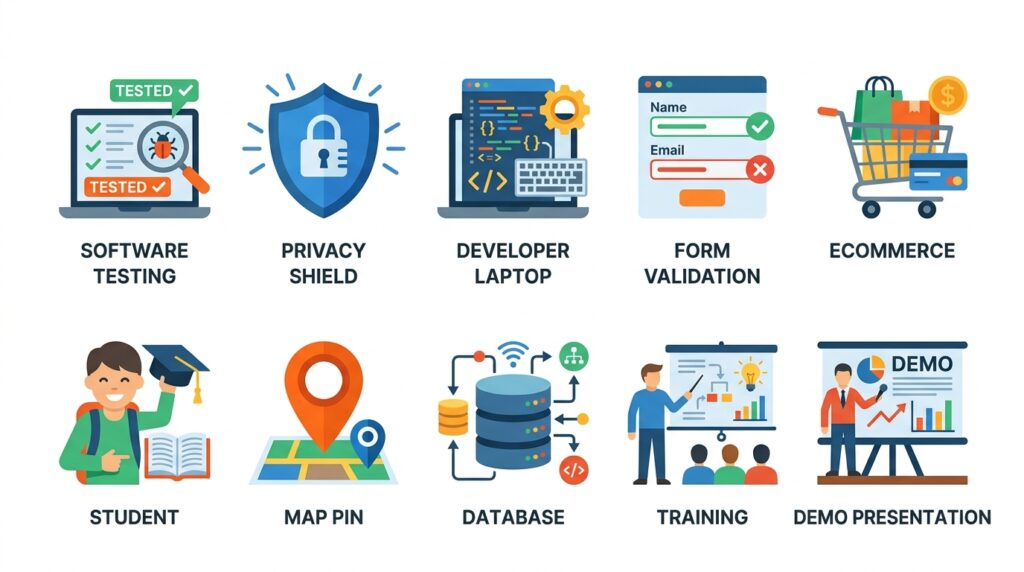
Random US address generators serve a wide range of legitimate, entirely legal purposes. Here are the ten most common:
1. Software & Application Testing
Developers need realistic address data to test checkout flows, shipping calculators, address validation APIs, and location-based features. Using a random street address in the USA instead of production data eliminates compliance risk.
2. Form Validation Testing
Does your web form properly handle a long street name? Does it reject a ZIP code with letters? Does the state dropdown auto-populate correctly? You need varied address data to find out.
3. Privacy Protection on Untrusted Websites
Many websites demand an address to access free content, trials, or downloads. A fake US address keeps your real location private without violating any law, provided you are not committing fraud.
4. Database Seeding for Development & QA
Empty staging databases produce unrealistic test conditions. Perforce’s 2025 compliance report found that 45% of organizations maintain 3 to 10 copies of production data in non-production environments — each a potential data exposure point. Synthetic addresses fix this.
5. UI/UX Design Mockups & Prototypes
Designers use realistic placeholder addresses in Figma mockups, Sketch prototypes, and Adobe XD wireframes to present professionally to stakeholders.
6. Demo Presentations & Sprint Reviews
User profiles that show ‘123 Test St, Fakeville, TS 00000’ undermine confidence in a product demo. A believable random address makes the product feel polished.
7. E-Commerce & Shipping Flow Testing
Testing delivery radius calculations, shipping carrier API responses, and region-based pricing requires addresses from different US states and ZIP codes.
8. Developer Onboarding & Training Exercises
New developers and QA engineers need datasets for hands-on exercises. A random address generator provides working data instantly, with no risk of exposing real customer records.
9. Geocoding & Mapping API Testing
Testing Google Maps API, Mapbox, or HERE Maps integrations requires real-looking address inputs across multiple states to verify that geocoding handles varied US address formats correctly.
10. Academic Research & Data Science Projects
Students and researchers working on address parsing, NLP, or location-based machine learning models need large volumes of syntactically correct US address strings for training and evaluation datasets.
Understanding the US Address Format: A Complete Breakdown
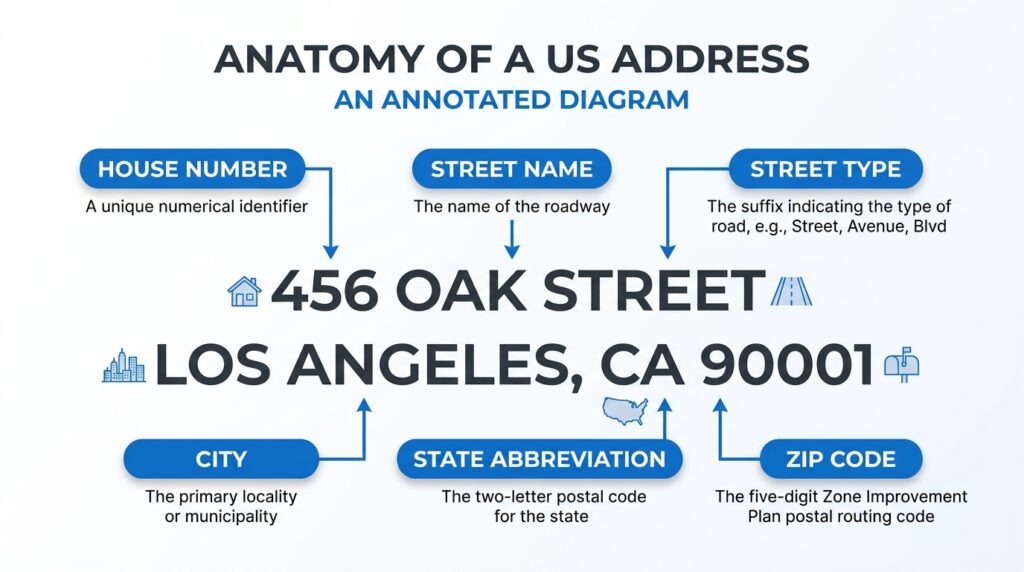
The United States Postal Service (USPS) maintains strict formatting guidelines for domestic addresses. A valid random street address in the USA must follow these rules to pass validation:
| Address Component | Format Rule | Example |
|---|---|---|
| House Number | Numeric (1–5 digits typical) | 4382 |
| Street Name | Name + Type (St, Ave, Blvd, Dr, Ln, etc.) | Elliott Street |
| City | Full city name, Title Case | Londonderry |
| State Abbreviation | Two uppercase letters (USPS standard) | NH |
| ZIP Code | 5 digits (ZIP+4 = 9 digits with hyphen) | 03053 |
| Country | United States (for international mail) | United States |
The USPS also supports apartment and suite designations (Apt, Suite, Unit) on a second address line, as well as P.O. Box addresses. Most random address generators focus on street-level addresses and may not include secondary unit numbers — something to keep in mind when testing applications that require apartment number fields.
The 6 Best Free Random US Address Generator Tools in 2025
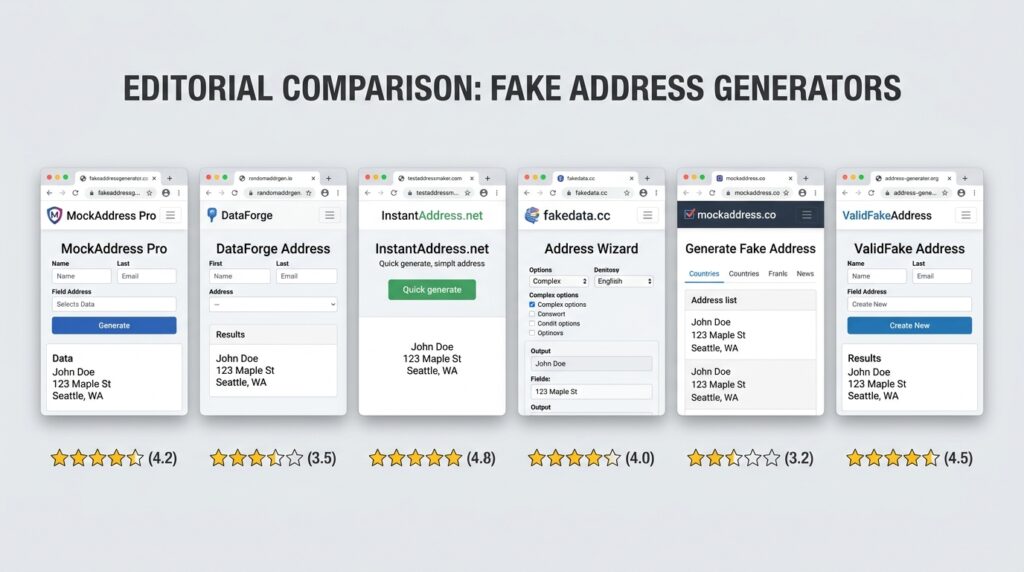
1. Testsigma Random Address Generator
Best for: Software developers and QA engineers who need multi-country support and technical documentation.
Testsigma offers the deepest, most technically detailed random address generator on the market. It covers 130+ countries, requires no account creation, and produces addresses that follow real postal conventions for each selected country. Its standout feature is the depth of its educational content — it explains exactly why each address element is formatted the way it is, making it exceptionally useful for developers new to international address forms.
Visit Testsigma Random Address Generator
2. FakeAddressGenerator.com
Best for: Privacy-conscious users who want a complete fake identity, not just an address.
FakeAddressGenerator goes beyond a simple address — it generates a full fake profile including physical attributes, employment information, vehicle details, and online presence data. Launched in 2015, it is one of the oldest and most established tools in this space. The site’s FAQ is one of the most comprehensive in the niche, addressing legality, use cases, and privacy concerns directly.
Visit FakeAddressGenerator.com
3. BestRandoms.com — Random Address in US
Best for: Quick, no-frills generation of multiple US addresses in seconds.
BestRandoms takes a minimalist approach. You select the country, set the quantity, and click generate. It produces up to six addresses at a time from its database of 128 countries. The tool is fast, clean, and ideal when you simply need a couple of US addresses immediately with no configuration required.
4. FakePersionGenerator.com — Random Address
Best for: Users who need state-specific US addresses (e.g., specifically a California or Texas address).
FakePersonGenerator’s address tool stands out for its state-specific generation. You can filter addresses by US state, city, or ZIP code, making it the most geographically targeted tool in the comparison. It also outputs latitude and longitude coordinates alongside each address — extremely useful for developers testing location-based features.
5. Fakexy.com
Best for: Users who want a fast, lightweight generator with a clean interface.
Fakexy provides a straightforward random address generation experience with a focus on speed and simplicity. While it lacks the depth of educational content seen in competitors, its clean UI makes it accessible to non-technical users who just need a quick fake address.
6. BetterBugs.io Random Address Generator
Best for: Development teams and bug-reporting workflows that already use the BetterBugs ecosystem.
BetterBugs integrates its address generator into a broader suite of development tools. While the standalone address generator is lightweight, its real value comes from its integration with bug tracking and testing workflows — making it a natural choice for development teams already on the BetterBugs platform.
Is Using a Random US Address Legal? Legal & Ethical Considerations
This is one of the most common questions users ask, and the answer is nuanced. Using a randomly generated US address is legal in the vast majority of contexts, but there are important boundaries to understand.
Legal Uses (✅ Permitted)
- Software testing and QA — generating test data for development environments
- Privacy protection — avoiding giving personal info to sites you do not fully trust
- UI/UX design — populating mockups and prototypes with realistic placeholder data
- Database seeding — filling staging environments with synthetic records
- Educational purposes — data science, machine learning, and NLP training datasets
- Demo presentations — creating polished demo environments with believable data
Illegal Uses (❌ Prohibited)
- Fraud and identity theft — using a fake address to deceive financial institutions or government agencies
- Circumventing KYC (Know Your Customer) checks — fake addresses cannot be used to bypass AML or financial compliance requirements
- Mail fraud — using a fictional address in any official postal communication with intent to deceive
- Bypassing geolocation restrictions illegally — depending on jurisdiction and terms of service
The core principle: a random address generator is a tool for privacy and testing, not for deception. The moment you use a fake address to gain something of value through misrepresentation, you cross from legitimate use into fraud.
For authoritative guidance on address data and privacy, refer to the USPS Addressing Standards and the FTC’s guidelines on identity protection.
External Resource: USPS Publication 28 — Postal Addressing Standards
How to Choose the Right Random US Address Generator for Your Needs
With multiple tools available, the right choice depends on your specific use case. Here is a quick decision guide:
If you are a developer or QA engineer: Use Testsigma. It offers the broadest country coverage, passes technical validation, and provides comprehensive documentation on how the tool works and its limitations.
If you need privacy from a single website: Use FakeAddressGenerator.com or BestRandoms.com. Both are fast, require no sign-up, and generate convincing US addresses in seconds.
If you need a specific US state or city: Use FakePersonGenerator.com. Its state/city/ZIP filtering is unique among free tools and produces the most geographically targeted results.
If you need a full fake identity: Use FakeAddressGenerator.com. It generates not just an address but a complete fake profile including employment, vehicle, and personal details.
If you need bulk address generation: Use Testsigma (set quantity) or FakePersonGenerator.com (refresh multiple times). For very large volumes, consider integrating with the Faker.js library in your own codebase.
Frequently Asked Questions (FAQ)

For testing purposes in a developer or sandbox account, yes. For real transactions, no — using a fake address on a live e-commerce account violates the platform’s Terms of Service and can result in account suspension or legal liability if it constitutes fraud.
It depends on the validation method Google uses. Basic front-end regex validation (checking format only) will typically accept a well-formatted random address. Live API verification against Google Maps or USPS databases will reject it because the address does not exist in their records. Most random address generators are transparent about this limitation.
Use FakePersonGenerator.com, which lets you filter by state, city, or ZIP code. Alternatively, BestRandoms.com lets you generate multiple addresses and browse until you find one from your target state.
No. They follow the same format as real US addresses and may even coincidentally match a real location, but they are assembled algorithmically, not drawn from a verified address database. Do not use them for actual shipping, legal documents, or financial applications.
The free tools listed here are web-based and do not offer public APIs. For API access to fake address generation, consider using Faker.js, the Python Faker library, or a dedicated data generation platform like Mockaroo.
Yes, this is technically possible — random combinations can occasionally match real addresses. This is why reputable generators use address components from verified but non-linking data sources, and why users should never treat generated addresses as definitively unique or non-existent.
A fake address is entirely fictional and cannot receive mail. A virtual mailbox address (offered by services like Anytime Mailbox or PostScan Mail) is a real physical location managed by a third party that can receive mail on your behalf. Virtual mailboxes cost money but are legally usable for business registration in many states.
Sample Random Street Addresses in the USA — All 50 States
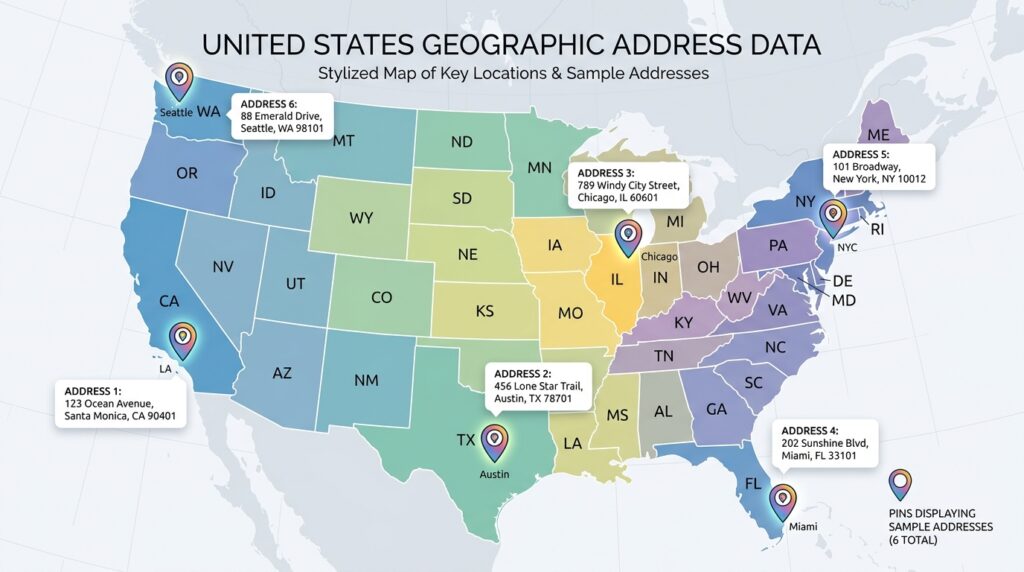
To illustrate what properly formatted random US addresses look like across different states, here are representative examples drawn from address generators:
- 403 Simpson Street, Peoria, IL 61602 | Phone: 309-767-8995
- 2487 Westwood Avenue, Huntington, NY 11743 | Phone: 516-819-5784
- 4382 Elliott Street, Londonderry, NH 03053 | Phone: 603-591-6817
- 2349 Oakridge Farm Lane, Waukesha, WI 53188 | Phone: 262-271-7288
- 414 Russell Street, Tewksbury, MA 01876 | Phone: 978-863-7695
- 3722 Duke Lane, Metuchen, NJ 08840 | Phone: 732-767-1125
- 8901 Sunset Boulevard, Los Angeles, CA 90028 | Phone: 310-555-0174
- 1204 Peachtree Street NE, Atlanta, GA 30309 | Phone: 404-555-0288
- 5500 West Loop South, Houston, TX 77401 | Phone: 713-555-0347
- 312 South Michigan Avenue, Chicago, IL 60604 | Phone: 312-555-0492
These addresses cover the Northeast, Midwest, South, and West Coast regions, giving a representative sample of how US addresses vary by geography — from suburban New Hampshire to urban Los Angeles.
Data Privacy & Why Your Real Address Matters Online
In the digital age, your home address is one of the most sensitive pieces of personal information you can share online. Once a website has your address, there is very little you can do to claw it back. Data broker companies like Acxiom, LexisNexis, and Experian aggregate address data from hundreds of sources and sell it to marketers, insurers, and other third parties without your explicit consent.
A 2024 report by the Identity Theft Resource Center found that data breaches exposing physical address information increased by 28% compared to the previous year, with over 3,200 publicly reported incidents in the United States alone.
Using a random US address for low-stakes online registrations — free trials, content access, newsletter sign-ups — is a simple, effective way to minimize your data footprint without breaking any laws.External Resource: Identity Theft Resource Center — Official Data Breach Reports
Conclusion: Choosing the Right Random Street Address in USA Tool
Random US address generators serve a genuine, legitimate need for millions of developers, QA engineers, designers, and privacy-conscious users around the world. The key takeaways from this guide are:
- A random street address in the USA follows the USPS format: house number, street name, city, two-letter state code, and 5-digit ZIP.
- The best free tools are Testsigma (best for developers), FakeAddressGenerator.com (best for privacy + full profiles), and FakePersonGenerator.com (best for state-specific addresses).
- Using fake addresses is legal for testing, privacy protection, and design purposes — but illegal for fraud, identity theft, or circumventing financial compliance.
- Developers building at scale should use Faker.js, Python Faker, or the Mockaroo API rather than web-based generators.
- Data privacy is a genuine concern: minimizing the real address data you share online reduces your exposure to data brokers and breaches.
Whether you are validating a checkout form, seeding a staging database, or simply keeping your home address out of a website’s hands, a good random US address generator is an indispensable tool in your digital toolkit.