What Is a Canada Address Generator?
A Canada address generator is a free online tool that instantly creates realistic, randomly generated Canadian addresses — complete with street names, house numbers, city names, provinces, and properly formatted postal codes. These addresses are entirely fictional and are not tied to any real person or actual location.
Unlike copying a real address from a map, a Canada address generator produces synthetic data that follows the official formatting conventions used across Canadian provinces and territories. The output looks and behaves exactly like a genuine Canadian mailing address, making it perfect for testing, development, privacy protection, and creative projects.
Whether you need a fake Toronto address, a random Vancouver postal code, or a fictional Quebec street name, a Canada address generator gives you instant results with zero effort.
Why Do People Use a Canadian Address Generator?
Every day, millions of people encounter situations where they need a Canadian address but don’t want to — or simply cannot — provide their real one. Here are the most common reasons people turn to a Canada address generator:
1. Privacy Protection
When signing up on websites that require address details for registration, many users are uncomfortable sharing their real home address. A fake Canadian address acts as a privacy shield, especially on platforms you don’t fully trust.
2. Software Testing and Development
Developers building applications that handle location data need large volumes of realistic test addresses. Using real addresses poses serious privacy and compliance risks. A Canada address generator provides clean, realistic test data with zero legal complications.
3. Form Validation Testing
QA engineers and testers routinely fill out web forms to check that address fields accept valid formats. Fake Canadian addresses with properly structured postal codes help validate input fields without exposing any real personal data.
4. Database Population
When building and testing databases, developers often need to seed them with realistic-looking user records — including addresses. A Canada address generator enables fast, bulk creation of test data that mirrors real-world datasets.
5. Educational Purposes
Teachers, students, and researchers working with geographic data, demographic studies, or data science projects often need sample Canadian addresses for exercises, assignments, or datasets.
6. Creative Writing and Game Development
Authors writing fiction set in Canada, screenwriters, game developers building open-world games, and app designers creating mockups all benefit from realistic, plausible Canadian addresses for their narratives and interfaces.
7. Bypassing Regional Restrictions
Some websites and online services restrict access to Canadian residents. A fake Canadian address can help users explore content on such platforms without revealing their true location.
How Does a Canada Address Generator Work?
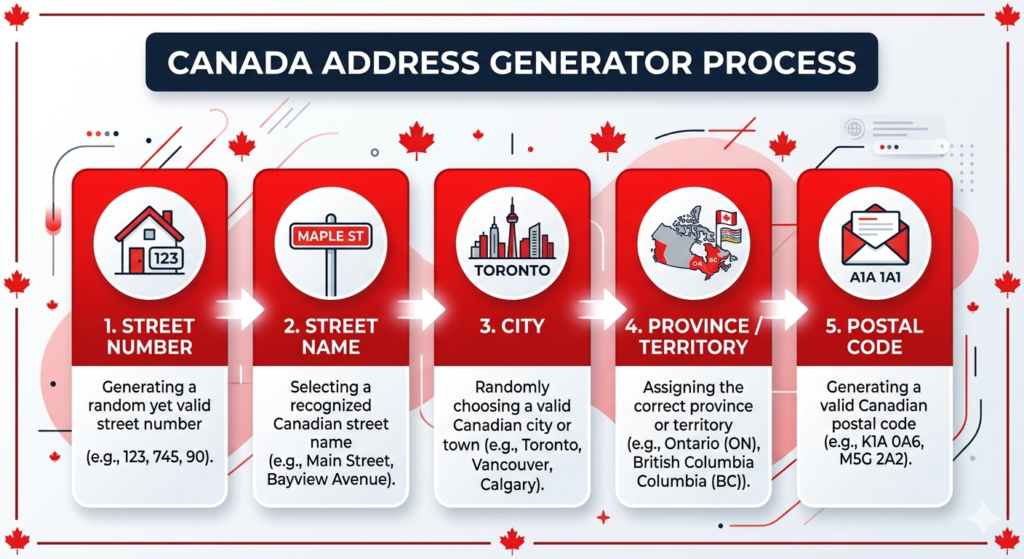
A Canada address generator uses a combination of algorithms and curated data libraries to assemble realistic address components in the correct Canadian format. Here is a breakdown of the mechanism:
Step 1 — Street Number Generation: The tool picks a random number within a realistic range (e.g., 1 to 9999) to serve as the house or building number.
Step 2 — Street Name Selection: It draws from a large library of authentic-sounding Canadian street names — including common types like “Maple Avenue,” “Rideau Street,” “Queensway Boulevard,” and “Lakeshore Drive.”
Step 3 — City Selection: The generator randomly picks a Canadian city, town, or municipality from a comprehensive list spanning all provinces and territories — from major urban centers like Toronto, Vancouver, Calgary, and Montreal to smaller towns like Canmore, Kentville, and Timmins.
Step 4 — Province Assignment: Each city is correctly matched to its corresponding province or territory, ensuring geographic accuracy.
Step 5 — Postal Code Generation: The tool generates a valid-format Canadian postal code following the official alphanumeric pattern (more on this below). The first letter of the postal code corresponds to the correct geographic region.
Step 6 — Assembly: All components are assembled into the standard Canadian address format and returned as a clean, copy-ready output.
Because no real personal data is used at any stage, the output is completely private, safe, and compliant with data protection standards like PIPEDA (Canada’s Personal Information Protection and Electronic Documents Act).
Understanding the Canadian Address Format
Before using or interpreting a generated Canadian address, it helps to understand how Canadian addresses are structured. Canada follows a specific address format that differs from the United States and the United Kingdom.
A standard Canadian mailing address looks like this:
[Recipient Name]
[Street Number] [Street Name] [Street Type] [Direction (if any)]
[Unit/Suite/Apt (if applicable)]
[City], [Province/Territory Abbreviation] [Postal Code]
[CANADA]
Real-World Example:
John Smith
245 Sparks Street
Ottawa, ON K1A 0A9
CANADA
Key Formatting Rules:
- Province abbreviations are always two capital letters (e.g., ON for Ontario, BC for British Columbia, QC for Quebec)
- Postal codes are six characters in the format A1A 1A1 (alternating letters and numbers, with a space in the middle)
- No comma is placed between the street number and the street name
- City and province are on the same line, separated by a comma
- Postal code follows the province abbreviation on the same line
Understanding this format is essential for generating and validating addresses correctly.
Canadian Provinces and Territories: A Full Address Guide
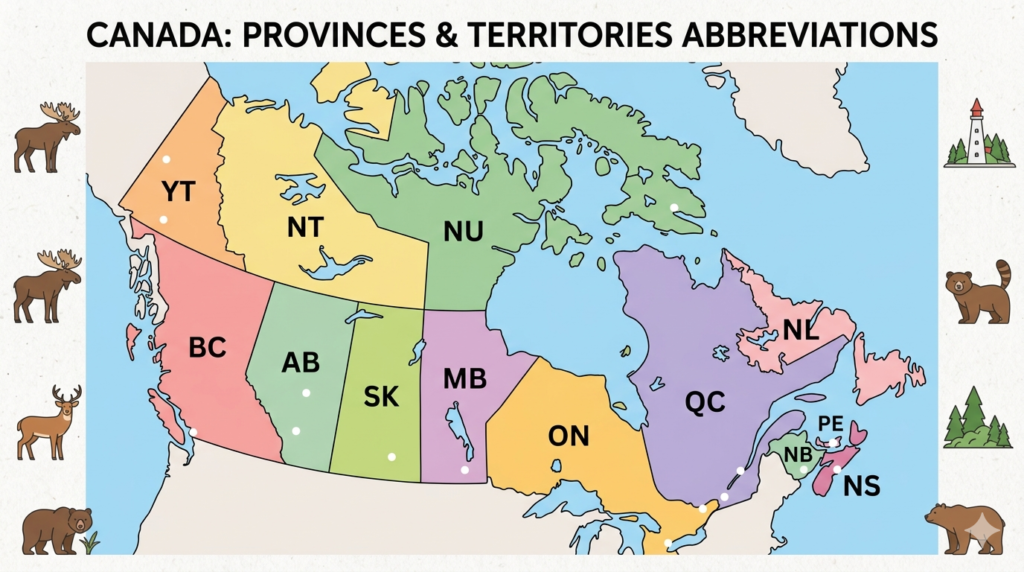
Canada is divided into 10 provinces and 3 territories, each with its own two-letter abbreviation used in addresses. Here is a complete reference:
| Province / Territory | Abbreviation | Capital City |
|---|---|---|
| Alberta | AB | Edmonton |
| British Columbia | BC | Victoria |
| Manitoba | MB | Winnipeg |
| New Brunswick | NB | Fredericton |
| Newfoundland and Labrador | NL | St. John’s |
| Northwest Territories | NT | Yellowknife |
| Nova Scotia | NS | Halifax |
| Nunavut | NU | Iqaluit |
| Ontario | ON | Toronto |
| Prince Edward Island | PE | Charlottetown |
| Quebec | QC | Quebec City |
| Saskatchewan | SK | Regina |
| Yukon | YT | Whitehorse |
A good Canada address generator will correctly pair cities with their provinces and use the proper two-letter abbreviation in the output. This is one of the key quality indicators to look for when choosing a generator tool.
How to Use a Canada Address Generator Step by Step
Using a Canada address generator is extremely straightforward. Here is a step-by-step walkthrough that applies to most tools:
Step 1: Visit the Generator Tool Open your browser and navigate to a Canada address generator website. Most are free, browser-based, and require no account or login.
Step 2: Select Your Province or City (Optional) Many tools allow you to filter by province (e.g., Ontario, British Columbia) or by specific city (e.g., Toronto, Calgary, Vancouver). If you need addresses from a specific region, use this filter. Otherwise, leave it on “random” for a completely random Canadian address.
Step 3: Choose the Number of Addresses Most tools let you generate anywhere from 1 to 100+ addresses at once. Enter the quantity you need.
Step 4: Click “Generate” Hit the generate button and your fake Canadian addresses will appear instantly on screen. Each address will include the street number, street name, city, province, and postal code.
Step 5: Copy and Use Use the copy button (usually provided next to each address) to copy the result to your clipboard. Paste it wherever you need — a web form, a spreadsheet, a test script, or a document.
Step 6: Regenerate if Needed If you need different addresses, simply click “Generate” again. Each click produces a fresh set of randomly generated Canadian addresses.
Top Use Cases for a Fake Canada Address
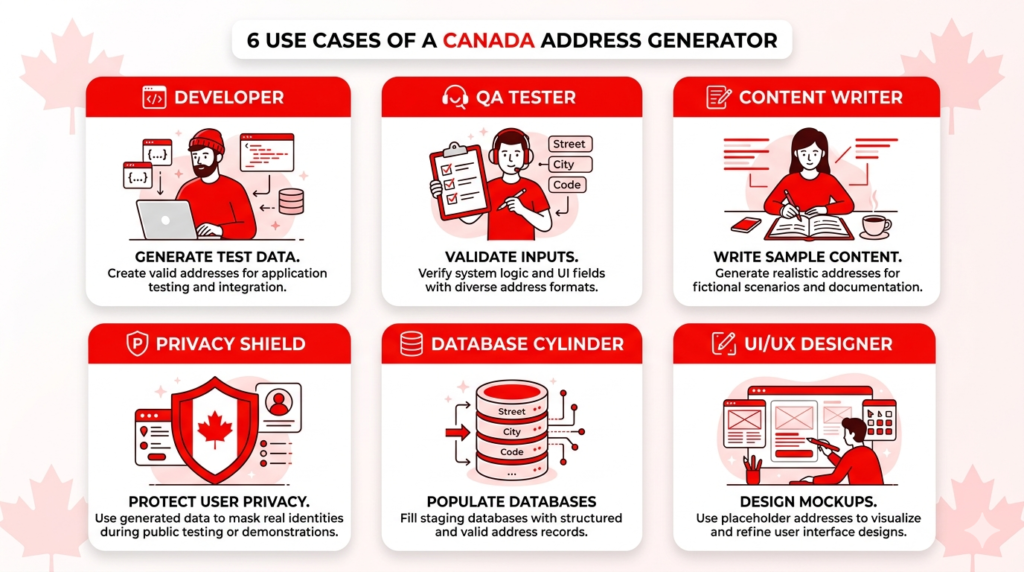
A fake Canadian address is more versatile than most people realize. Here are the most valuable use cases across different industries and scenarios:
For Developers and Software Engineers
- Populating test user profiles in staging environments
- Testing geocoding and reverse geocoding APIs with Canadian address inputs
- Validating postal code regex patterns for Canadian formats (A1A 1A1)
- Seeding development databases with realistic-looking location data
- Testing address normalization and parsing services
For QA and Test Engineers
- Automating form fill tests across checkout, signup, and profile pages
- Testing shipping and billing address validation in e-commerce platforms
- Verifying that tax calculation systems respond correctly to different Canadian provinces
- Stress-testing database imports with bulk Canadian address records
- Checking UI rendering of address fields across different screen sizes
For Business Analysts and Data Scientists
- Creating synthetic datasets for location-based analysis without using real personal data
- Training machine learning models on address recognition and parsing
- Building demo dashboards with realistic Canadian location data
For Marketers and UX Designers
- Creating realistic mockups and prototypes that include address fields
- Populating wireframes and design files with authentic-looking Canadian data
- Producing demo environments that look production-ready for client presentations
For Writers, Game Developers, and Creators
- Inventing fictional character home addresses for novels or screenplays
- Generating location data for open-world video games set in Canada
- Creating roleplay game (RPG) character backstories with realistic home cities
For Privacy-Conscious Internet Users
- Registering on websites that demand an address without sharing your real one
- Filling in required address fields on platforms you don’t fully trust
- Protecting yourself from data brokers who harvest mailing addresses
Canada Address Generator for Developers and QA Testers
For development and QA teams, a Canada address generator is an indispensable productivity tool. Let’s break down specifically how it fits into professional workflows.
Form Validation Testing
Address input forms are among the most common and most error-prone components in web applications. Testing them requires realistic data. A fake Canadian address with a properly formatted postal code (e.g., M5V 2T6) will:
- Pass front-end regex validation for the Canadian postal code format
- Trigger geolocation lookups correctly
- Exercise provincial dropdown logic (ensuring “Ontario” maps to “ON”)
- Test multi-line address field rendering
API Testing
Many backend systems integrate with third-party address verification, shipping calculation, or geolocation APIs. Before going live, developers need to stress-test these integrations with realistic inputs. Generated Canadian addresses provide safe, realistic payloads for:
- Canada Post address validation APIs
- Shipping cost calculation APIs (FedEx, UPS, Purolator)
- Geolocation services (Google Maps, Mapbox)
- Tax and HST/GST calculation engines
Database Seeding
Modern applications often need thousands of user records during development. Manually creating realistic address records is impractical. A Canada address generator enables developers to create bulk address datasets instantly. Tools that export to JSON, CSV, or SQL formats are particularly useful for database seeding workflows.
Automated Test Suites
Test automation frameworks like Selenium, Playwright, and Cypress require test data. Generated Canadian addresses can be embedded directly into test fixtures, data-driven test cases, and parameterized test scripts. This eliminates the risk of hardcoding a real person’s address into a codebase.
External Resource: Learn more about best practices for test data management from Ministry of Testing – Test Data Guide — one of the leading communities for software testing professionals.
Is It Legal to Use a Fake Canadian Address?
This is one of the most commonly asked questions about Canada address generators, and the answer depends on how and where you use the generated address.
Legal Uses ✅
Using a fake Canadian address is entirely legal for:
- Software testing and development
- Database population and QA workflows
- Educational exercises and classroom projects
- Creative writing, fiction, and game development
- Filling in address fields on websites you don’t trust to protect your privacy
- Creating demo environments and UI mockups
Potentially Illegal Uses ❌
Using a fake Canadian address is potentially illegal (and unethical) when:
- Registering for government services using fraudulent identity information
- Committing tax fraud by providing a false address to the Canada Revenue Agency
- Opening bank accounts or financial services with fraudulent address details
- Bypassing geographic restrictions in ways that violate a platform’s terms of service to commit fraud
The key distinction is intent. Using fake addresses for privacy protection, testing, or creative purposes is widely accepted and legal. Using them to defraud others, impersonate real individuals, or obtain services through deception is illegal.
Important Note: Always read the terms of service of any platform you use. While protecting your privacy with fake data is generally acceptable, deliberately bypassing fraud controls or deceiving organizations can have serious legal consequences.
Canadian Postal Code Format Explained
The Canadian postal code is one of the most distinctive features of a Canadian address. Understanding its format is essential for generating and validating addresses correctly.
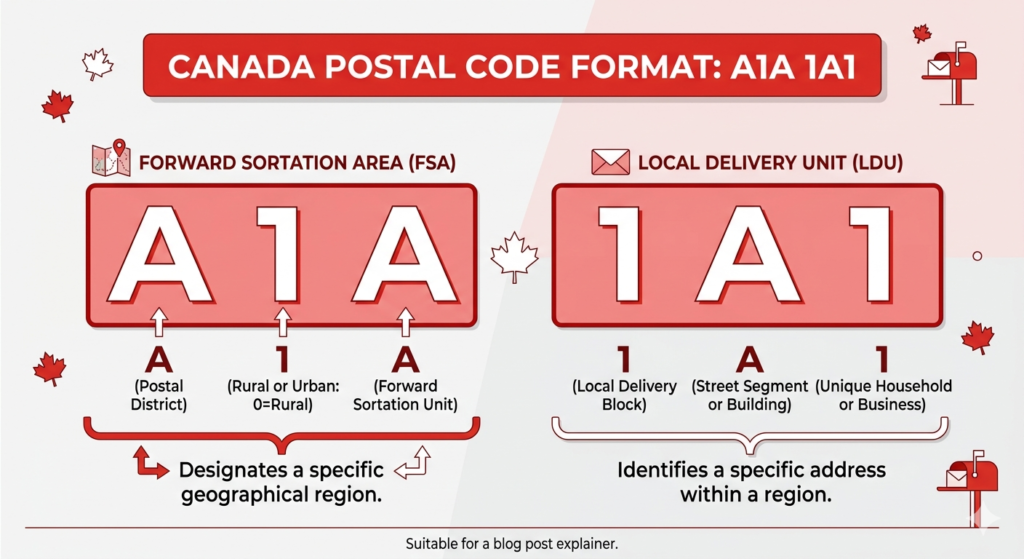
The Format: A1A 1A1
Canadian postal codes are six characters long, alternating between letters (A) and numbers (1), with a space in the middle:
- First character (Letter): Identifies the postal district (Forward Sortation Area)
- Second character (Number): Identifies the rural (0) or urban area
- Third character (Letter): Further narrows the geographic area
- [Space]
- Fourth character (Number): Local delivery unit
- Fifth character (Letter): Identifies the block face or building
- Sixth character (Number): Pinpoints the exact delivery unit
Examples of Valid Canadian Postal Codes by Province:
| Province | Example Postal Code | Starting Letter |
|---|---|---|
| Ontario | M5V 2T6 | M, K, L, N, P |
| British Columbia | V6B 4N6 | V |
| Quebec | H3A 1Y7 | G, H, J |
| Alberta | T2P 3C3 | T |
| Nova Scotia | B3K 5X5 | B |
| Manitoba | R3C 1B1 | R |
| Saskatchewan | S4P 3Y2 | S |
A high-quality Canada address generator ensures that the postal code’s first letter matches the province of the generated address. This is a critical detail that separates well-built generators from low-quality ones.
External Resource: For the official postal code lookup tool in Canada, visit Canada Post’s Find a Postal Code — the authoritative source for all Canadian postal code information.
Canada Address Generator vs. Other Country Generators
If you work with international data, you may need address generators for multiple countries. Here is how Canadian addresses compare to other popular formats, and what to look for in a global address generator:
| Feature | Canada | United States | United Kingdom | Australia |
|---|---|---|---|---|
| Postal Code Format | A1A 1A1 (alphanumeric) | 12345 (5-digit numeric) | SW1A 1AA (alphanumeric) | 4 digits (numeric) |
| Province/State Field | Province (13 total) | State (50 total) | County (optional) | State/Territory |
| Official Languages | English & French | English | English | English |
| Address Line Format | Number + Street, City, Province, Postal | Number + Street, City, State, ZIP | Number + Street, City, County, Postcode | Number + Street, Suburb, State, Postcode |
When choosing a Canada address generator, look for tools that specifically support the Canadian postal code format (not just a generic five-digit number), include all 13 provinces and territories, and correctly format bilingual city names (especially for Quebec).
External Resource: For understanding global address formats across 240+ countries, GeoNames.org is an excellent open-source geographic database used by developers worldwide.
Privacy and Data Security: Why Fake Addresses Matter
In an era of rampant data breaches, identity theft, and data harvesting, protecting your personal information has never been more important. A Canada address generator plays a meaningful role in digital privacy protection.
The Problem with Sharing Your Real Address Online
Every time you enter your real home address on a website, you are creating a data record that may be:
- Sold to data brokers and marketing companies
- Exposed in a data breach
- Used for unsolicited physical mail or targeted advertising
- Combined with other personal data to build a profile on you
Canada’s privacy legislation — specifically PIPEDA (Personal Information Protection and Electronic Documents Act) — gives Canadians rights over their personal information. However, once you voluntarily submit your address to a website, enforcement becomes difficult.
How a Fake Address Protects You
By using a generated Canadian address instead of your real one for non-essential sign-ups, you:
- Prevent your home address from entering third-party databases
- Reduce your exposure to physical junk mail
- Limit the personal data available to be breached in cyberattacks
- Maintain anonymity on platforms that don’t genuinely need your location
This is particularly valuable when signing up for one-time-use services, accessing free trials, or registering on websites in countries with weaker privacy protections than Canada.
External Resource: Learn more about your digital privacy rights as a Canadian at the Office of the Privacy Commissioner of Canada — the federal authority on privacy law in Canada.
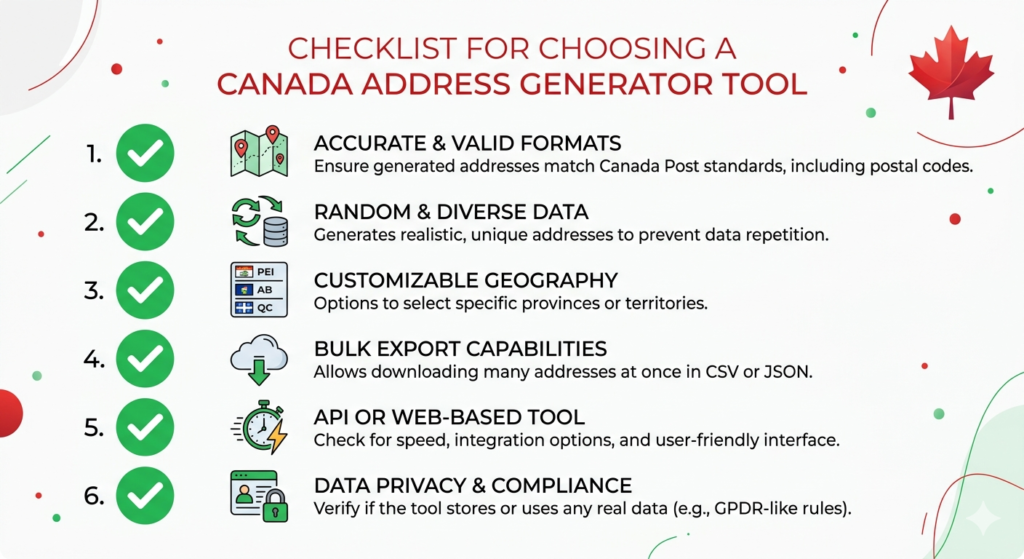
Tips for Choosing the Best Canada Address Generator Tool
Not all Canada address generators are created equal. Here is what to look for when selecting the right tool for your needs:
✅ Correct Postal Code Format
The tool must generate postal codes in the proper A1A 1A1 format — with the first letter corresponding to the correct province. A tool that generates “12345” as a Canadian postal code is unreliable.
✅ All Provinces and Territories Covered
A comprehensive generator includes all 13 Canadian provinces and territories — not just Ontario and British Columbia. Look for coverage of Nunavut, Yukon, Northwest Territories, and Prince Edward Island.
✅ Realistic Street Names
High-quality generators draw from libraries of authentic Canadian street names, including bilingual names for Quebec addresses. Generic street names like “Main Street” for every address are a red flag.
✅ City-to-Province Accuracy
Generated cities should be correctly matched to their real province. A tool that pairs “Calgary” with “Ontario” is producing inaccurate data.
✅ Bulk Generation Capability
For development and testing use cases, the ability to generate multiple addresses at once — and export them in CSV, JSON, or other formats — is extremely valuable.
✅ No Registration Required
The best tools are completely free and require no account creation or login. Your usage should be anonymous.
✅ Mobile-Friendly Interface
A good generator works smoothly on mobile browsers, tablets, and desktop computers without requiring any software installation.
✅ Privacy-Respecting Tool
The generator itself should not log your usage, require personal information, or store generated addresses. Read the tool’s privacy policy before using it for sensitive testing workflows.
Frequently Asked Questions (FAQs)
No. Addresses produced by a Canada address generator are entirely fictional. They follow the correct formatting of real Canadian addresses but are not tied to any actual location, building, or person. They should never be used for real mail delivery, legal filings, or financial transactions.
Canadian postal codes follow the format A1A 1A1 — six alphanumeric characters alternating between letters and numbers, with a space in the middle. The first letter indicates the broad geographic region (called a Forward Sortation Area).
Yes. Most Canada address generators allow you to filter by province or even by city. This is useful when you specifically need addresses from Ontario, British Columbia, Quebec, Alberta, or any other specific region.
Yes. The majority of Canada address generator tools are completely free and require no registration or login. You can generate as many addresses as you need without any cost.
Absolutely. Generated Canadian addresses are ideal for automated testing. They provide realistic, validly formatted data without exposing any real personal information. Many QA engineers incorporate generated addresses into Selenium, Playwright, Cypress, and other test automation frameworks.
In most cases, yes — because the address follows the correct formatting rules (valid postal code pattern, real city name, correct province abbreviation). However, some services perform live address verification against Canada Post’s database, which would reject fictional addresses.
Yes. Many Canada address generators support bulk generation, allowing you to create anywhere from a few to hundreds of addresses at once. Some tools also offer export options in CSV, JSON, or plain text format for easy integration into development workflows.
Using a fake address for personal privacy protection, software testing, or creative projects is generally legal. It becomes illegal when used to commit fraud, deceive financial institutions, or evade law enforcement. Always use generated addresses responsibly and ethically.
A generated Canadian address usually includes: street number, street name, street type (Street, Avenue, Boulevard, etc.), city or municipality, province or territory with its two-letter abbreviation, and a properly formatted postal code. Some generators also include a phone number, a full name, and other profile details.
The first letter of a Canadian postal code is called the Forward Sortation Area (FSA) code. It identifies the broad geographic region where the address is located. For example, postal codes beginning with “M” are in Toronto, “V” codes are in British Columbia, and “G” or “H” codes are in Quebec. A good Canada address generator matches this letter to the correct province.
Conclusion
A Canada address generator is one of those quiet, workhorse tools that developers, testers, writers, and privacy-conscious users reach for constantly — yet it rarely gets the recognition it deserves. Whether you’re seeding a test database, validating an address form, protecting your privacy online, or building a fictional world set in Canadian cities, these tools deliver instant, realistic, properly formatted Canadian addresses at the click of a button.
The key differentiators between a great Canada address generator and a mediocre one come down to postal code accuracy, province-to-city correctness, bulk generation capabilities, and clean bilingual support for Quebec. With those boxes checked, you have a tool that serves equally well in a professional development environment and in a casual privacy-protection scenario.
As data privacy becomes increasingly important worldwide — and as Canada continues to strengthen its PIPEDA legislation — the ability to use realistic fake addresses instead of your real personal information becomes not just convenient, but genuinely important.
Use these tools responsibly, use them legally, and let them protect your privacy while powering your projects.
Try Our All Country Address Generator.